The Concurrences Innovation Ecosystem: Legal and Economic Perspectives Conference was held on 16 March 2026 at Kings College, London. The conference brought together senior competition practitioners, regulators, judges, and academics to discuss pressing issues in UK and EU competition law across panels on merger control reform, digital markets regulation, cartel enforcement, EU-UK cooperation, and class actions. Having recently published their piece on the UK DMCCA regime with Concurrences, Oles Andriychuk and Anush Ganesh from the SCiDA Team attended the conference. This post provides a summary of the key themes from the day.
by Anush Ganesh
Opening Fireside Chat: Competition, Growth, and the CMA’s Trajectory
The conference opened with a fireside chat featuring Marcus Bokkerink, former Chair of the CMA, in conversation with Bill Kovacic of George Washington University and Renato Nazzini KC (Hon) of King’s College London. Marcus discussed what can drive growth in the United Kingdom and emphasised that competition is an important driver of economic prosperity. In support of the CAT’s powers in relation to the collective proceedings regime, he noted that private enforcement has largely emerged as a response to perceived gaps in public enforcement.
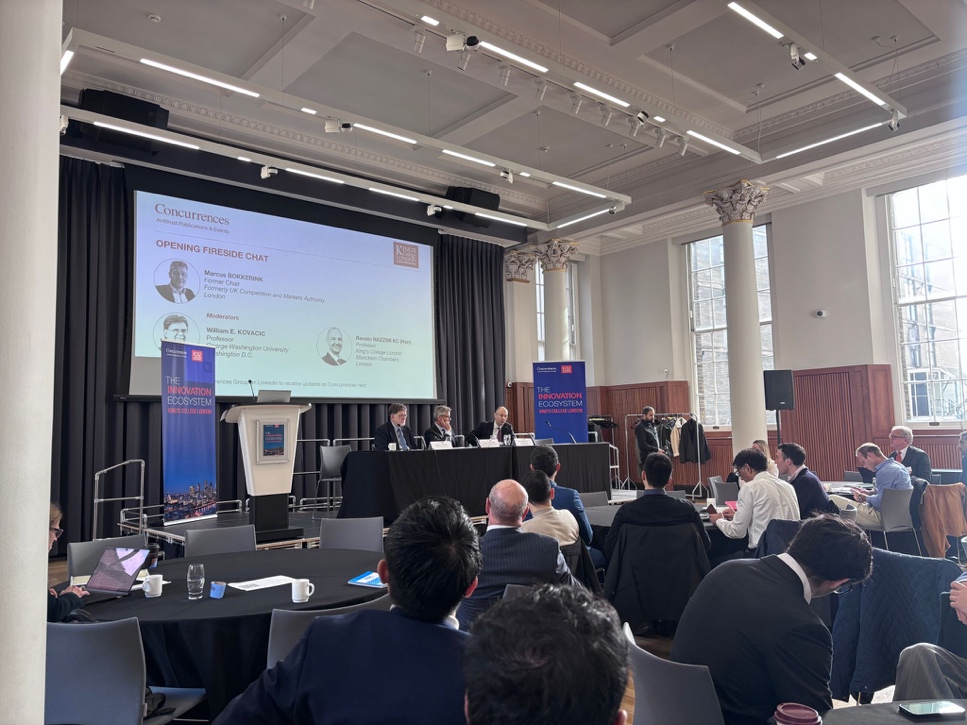
He was clear that competition law is a powerful tool for fostering innovation, but observed that the CMA has moved to a different trajectory in recent years, actively slowing certain processes. Work under the DMCCA has also been relatively slow, although cartel enforcement activity in public procurement and algorithmic collusion has been notable. Bill raised the example of small companies manufacturing drones, where competition had driven smaller firms to improve, and asked whether there has been a failure to consider competition as a strength. Renato raised the broader point that competition law used to be more independent of private action and posed a number of cross-cutting questions throughout the session.
Panel 1: Efficiency or Resilience? Redefining Merger Control
The first panel examined the evolution of merger control in the EU and UK. Gönenç Gürkaynak of ELIG Gürkaynak Attorneys-at-Law offered a Schumpeterian perspective, arguing that regulation does not equate to innovation and that merger control rules contribute to the EU’s lack of scale. He described the consideration of efficiencies as the correct approach but cautioned that practical application remains to be seen, and discussed the distinction between static and dynamic efficiency alongside the relevance of complexity economics. Matthew Levitt of Baker Botts discussed the UK pre and post Brexit, arguing that the UK had prevented mergers where it should not have, contributing to the shift towards the CMA’s growth agenda.
He noted the new requirement for ministerial sign-off as a consequence of the CMA’s earlier interventionist posture and emphasised the need for a conceptual framework for efficiencies. Luke Woodward of the Australian Competition and Consumer Commission explained how Australia’s regime has followed a similar path, with careful assessment of vertical and conglomerate theories of harm. The panel was moderated by Maria Ioannidou of Queen Mary University of London.
Panel 2: The UK’s Digital Turn Under the DMCCA and the EU’s DMA Enforcement Surge
The second panel explored digital regulation under the DMCCA and DMA. Cleo Alliston of the BBC noted that the CMA’s acceptance of voluntary commitments from Apple and Google lacks a statutory basis, suggesting unwarranted trust in big tech, and highlighted challenges faced by media organisations that need data in return for their news content being used by platforms. Lucia Bonova of DG COMP argued that it is too early to judge the DMA, pointing to active work on specification decisions and compliance assessments, including Apple’s interoperability obligations.
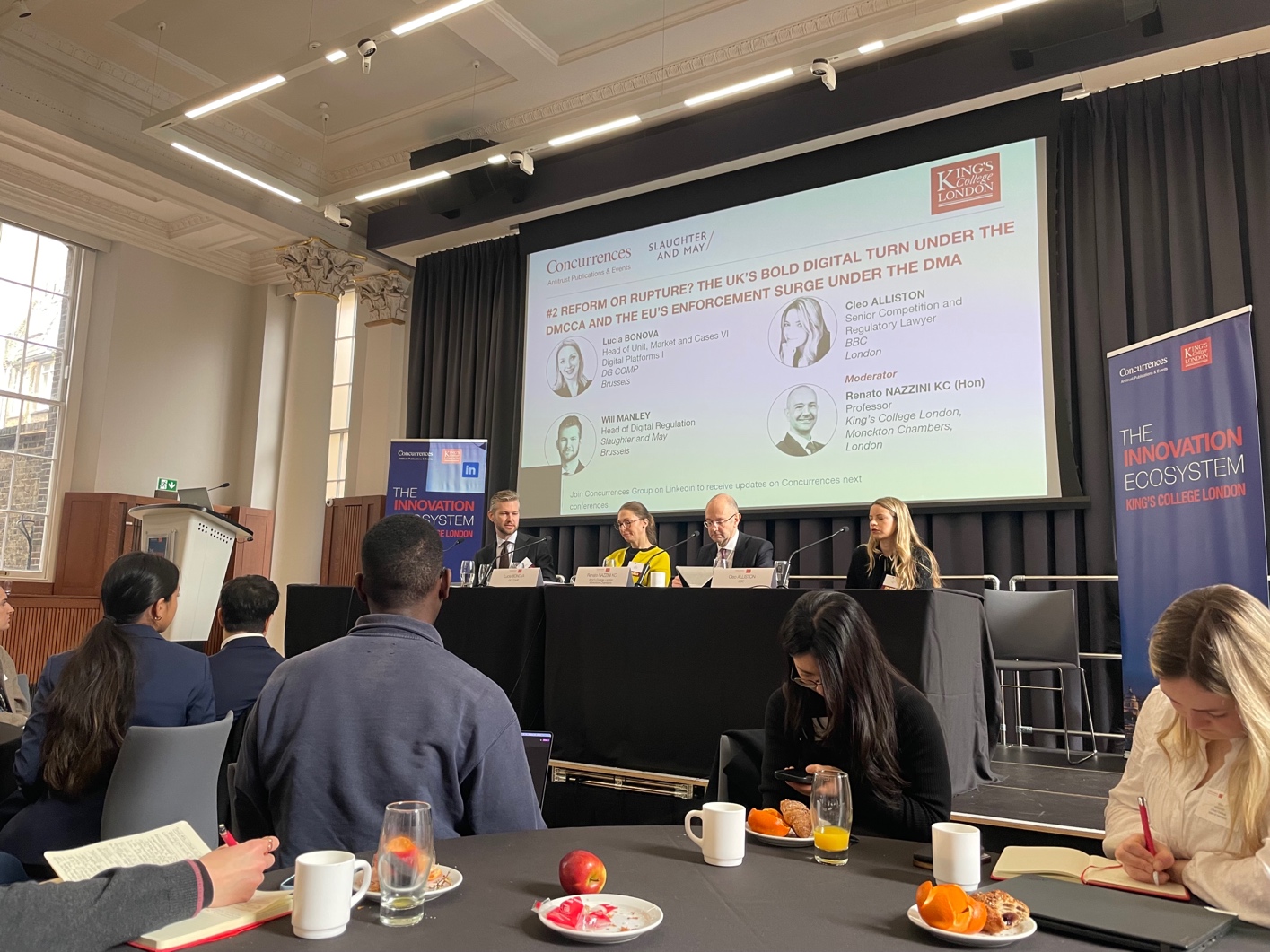
Lucia noted that AI services and AI assistants are within the scope of future intervention, stressed that choice architecture is fundamental to choice screen design, and stated clearly that the DMA is not a bargaining tool in trade matters. Lucia expressed limited confidence in commitments from big tech and referred to the DMA’s “three strikes” rule. Will Manley of Slaughter and May observed that the CMA’s DMCCA implementation has been staggered and that dialogue exists in EU enforcement. The panel was moderated by Renato, who concluded that it is still too early to judge either regime.
International Cooperation on Competition Policy
The afternoon fireside chat, moderated by Annabelle Gawer of the University of Surrey, focused on EU-UK competition cooperation. Nicole Kar of Paul Weiss highlighted the clear benefits of the Trade and Cooperation Agreement while noting friction with US agencies as a point of consideration and questioning whether the CMA can operate independently. Nicolas Rey of the EU Delegation to the UK emphasised that competition has been one of the aspects of lesser debate during TCA negotiations, and clarified that the DMA is not within the TCA’s scope. Alex Williams of the Department for Business and Trade echoed the view that discussions have been constructive.
Panel 3: Cartels Beyond Price Fixing: Labour and Green Collusion
This panel examined expanding cartel enforcement. Sophie Albrighton of BT Group discussed the scrutiny of no-poach agreements and questioned whether these are competition law or labour law issues. She noted that the European Commission appears more open than the CMA to considering non-competes as restrictive of competition. Jorge Ferreira of the Portuguese Competition Authority discussed cases including CD Tondela, currently a preliminary reference before the CJEU.
Juan Rodriguez of Sullivan and Cromwell discussed the end-of-life cars case under Directive 50/2000, which raised two distinct issues: demand-side collusion on dismantling costs (a standard input cartel) and an agreement to treat publicity as a non-competitive issue, representing a novel and elastic interpretation of anti-competitive agreements that also led to UK-EU post-Brexit cartel coordination. Ingrid Vandenborre of Skadden explained that no-poach and no-hire agreements are by-object restrictions unless shown to be ancillary restraints, and emphasised the need to assess their direct impact on individuals. The panel was moderated by Alison Jones of King’s College London.
Panel 4: Class Actions and Litigation Funding
The final panel was among the most substantive of the day. Justice Kelyn Bacon, President of the CAT, provided a detailed overview, noting that Kent v Apple remains the only case with a damages award (see our case note here). She highlighted disputes between funders and class representatives as a risk, stressed that taking on the class representative role is serious (requiring independent and robust engagement, not a figurehead role), and discussed how the Evans decision allows consideration of merits at certification. On settlement and distribution, she noted low take-up in Gutmann (£25 million settlement, approximately £200,000 to the class) alongside the McLaren (£100 million) and Merricks settlements and the pending Qualcomm case (£500 million). Bacon acknowledged that the CAT cannot manage the current volume of submissions and that the regime is for class members, not lawyers or funders. When asked whether the CAT has become a body of last resort, she acknowledged this may be the case.
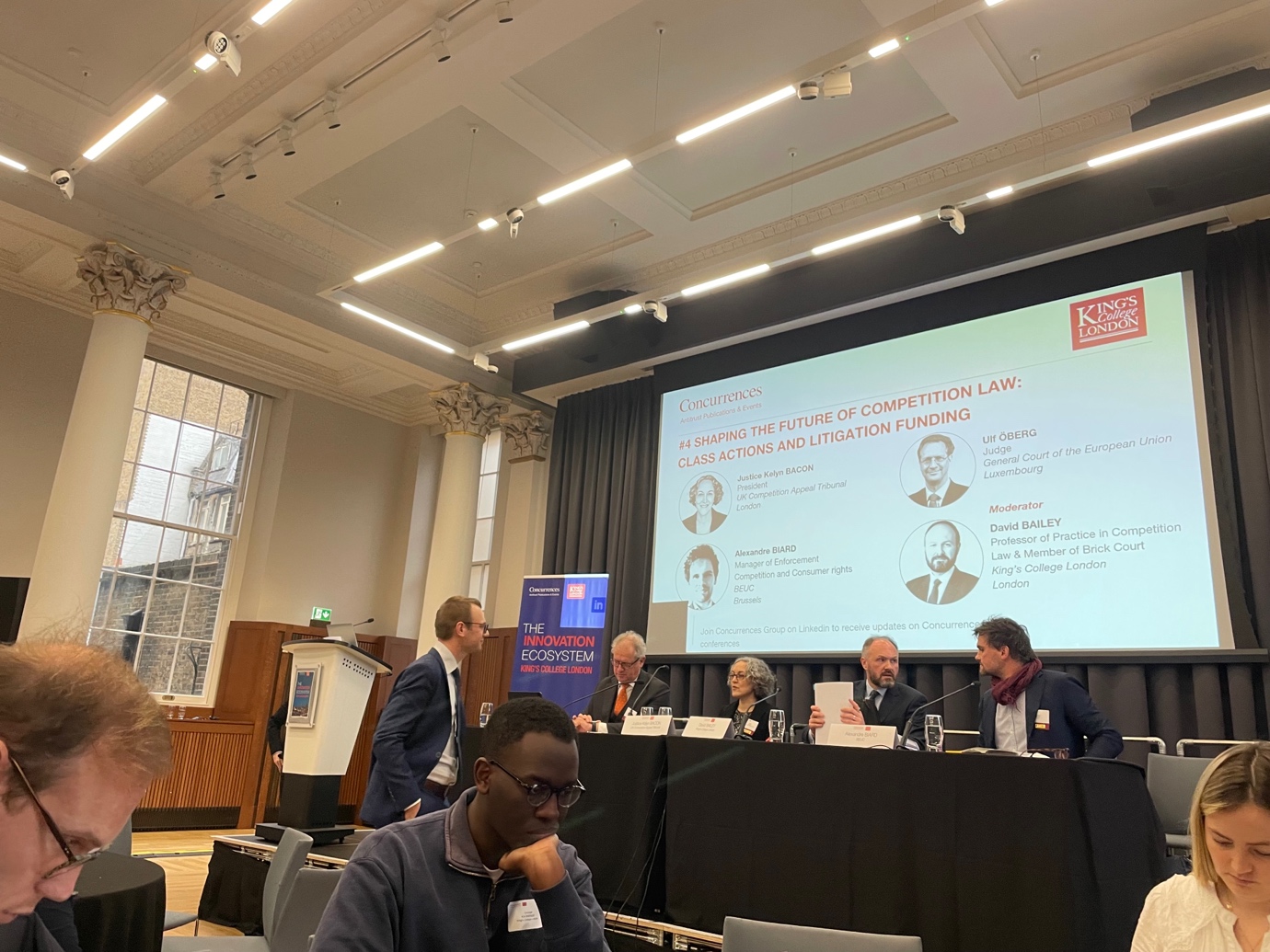
Judge Ulf Öberg of the General Court noted considerable variation in private enforcement across Europe, with as many positions as there are Member States. He discussed cases where class actions have been prevalent, such as airline delay litigation, and noted that private litigation as an alternative to public enforcement raises important questions about evidence and access to information.
Alexandre Biard of BEUC drew a striking contrast between France (zero class actions despite ten years of legislation) and the active UK regime, identified the need for effective opt-out mechanisms and funding, and argued that collective action is an important supplement to, rather than a replacement for, public enforcement. When asked about the absence of claims in France, he pointed to access to funding and other structural factors, and suggested that limiting lawyer fees within certain bounds can be beneficial. On the prospect of an EU-wide settlement regime in the wake of Dieselgate, he noted that this is unlikely. The panel was moderated by David Bailey of King’s College London, who noted aggregate claims of approximately £160 billion in UK collective proceedings to date.
Looking Ahead
The conference provided a timely and wide-ranging assessment of UK and EU competition law at a moment of significant transition. Recurring themes included the tension between fostering growth and maintaining robust enforcement, the challenges of implementing new digital markets regimes under the DMCCA and DMA, the expanding boundaries of cartel enforcement into labour markets and green collusion, and the growing significance of private enforcement through class actions and collective proceedings. For the SCiDA project, which examines competition in the digital age across the EU, UK, and Germany, the discussions reinforced the importance of comparative regulatory analysis and the value of tracking how legal doctrine and enforcement practice are developing in real time across both jurisdictions.