The first private DMA enforcement judgment by a German appellate court has arrived, and it is about tying: the Higher Regional Court of Koblenz (Oberlandesgericht) has held that the Google Account sign-up design breaches Article 5(8) DMA by favouring Gmail in the process (U 851/25 Kart). The competing email providers GMX and Web.de obtained an EU-wide injunction against Alphabet. The judgment was handed down within a relatively decent time frame and offers a portable test for tying through platform design. In this post, Sebastian Steinert dissects the judgment and analyses what it means for private enforcement and cooperation between national courts and the Commission.
By Sebastian Steinert
1. Re: Court Rejects Alphabet’s Tying Setup
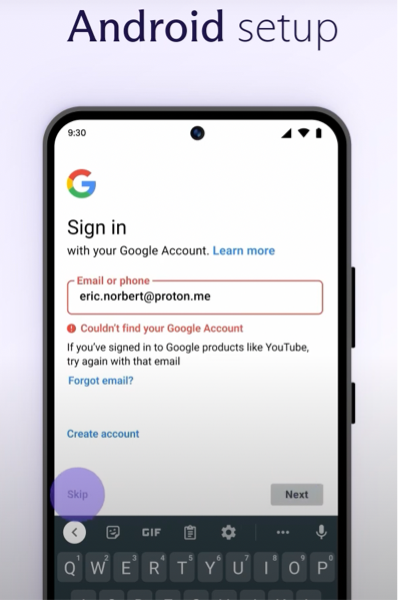
If you’ve ever set up an Android phone (like at least 60% of Europeans), you will have created a Google Account (if you did not have one yet). Setting up a Google Account required for a long time the use of Alphabet’s own e-mail service, Gmail. Welcome to the G-ecosystem! With this strategy, Alphabet turned every Android user into a Gmail customer. Similar tying arrangements were in place for Google Play, Chrome and YouTube. Once the DMA kicked in, Alphabet started to allow alternative e-mail addresses to be used for the set-up (at least after some complaints). However, the design of the setup procedure was still capable to steer users to Gmail, or so it was argued by its German competitors GMX and Web.de (1&1 Mail & Media). The e-mail provider, located in lovely Montabaur, sued for an injunction in its German home court Mainz. Germany had explicitly extended its procedural competition law provisions to DMA claims (Sec. 33 (1) GWB).
After an initial win in first instance (Regional Court of Mainz (Landgericht)), now the Higher Regional Court of Koblenz also sided with the claimants: Alphabet’s process of setting up Google Accounts infringes the anti-tying provision in Article 5(8) DMA. Since neither party appealed, this seems to be nothing less than the first final ruling on DMA private enforcement in all of the European Union.
What’s the remedy ordered by the court? From now on, Alphabet must either allow alternative e-mail addresses to be used in an equal manner to Gmail or provide another alternative (e.g. registration with a phone number) without activating a usable Gmail account in the background. For the court the decisive factor in determining whether alternatives are on an equal footing with Gmail is whether their practical usability is “sufficiently attractive” to users.
2. The Fairytale of Free Choices on Gatekeeper Platforms
Gmail is not designated as a core platform service (CPS) under the DMA, but it exceeds the user thresholds of Article 3(2)(b) DMA. That is enough to bring it within Article 5(8) DMA, which forbids a gatekeeper from requiring users to register for such a service in order to use its designated CPS. According to the court, “requiring” must be read broadly. Not just contractual requirements and economic pressure fall under the notion, but also a platform design that makes the gatekeeper service more attractive than the alternatives. The court rightly referred to a gatekeeper’s power to steer user decision-making through its platform design. While Alphabet argued that users are free to bring their alternative e-mail addresses, the court did not fall for the fairytale of free user choices on gatekeeper platforms.

It analysed the Android setup process in detail and found significant disadvantages for the alternative option, which made it less attractive than Gmail:
- If the user does not have an e-mail address readily available when setting up a Google account, a Gmail account can be easily created within the same interface. For an alternative provider’s address, however, the set-up must be interrupted, and the address has to be obtained outside.
- And even if the user does have a functioning alternative e-mail address, its usage is made difficult by Alphabet: the address needs to be verified with a code on a second device before it could be used for the account (which, of course, is not required for Alphabet’s in-house service). On this point, the Higher Regional Court went further than the first instance. The Regional Court of Mainz did not see the verification process as an obstacle, as every user can be expected to have a second device at hand. Koblenz disagreed: users cannot be expected to have a device readily available at all times, and even if they do, the break in the flow and the delay are enough to nudge users towards Gmail, so this alternative was not sufficiently attractive.
The court did not, however, grant the claimants a general right to access Alphabet’s setup process of Google Accounts (e.g. via a choice screen, as envisioned for browsers by Article 6(3) DMA). It is acceptable for Alphabet to offer one single sufficiently attractive alternative to Gmail. This alternative doesn’t have to be alternative e-mail addresses but can also be a registration with a phone number, as long as no usable Gmail address is created along the way (a solution Alphabet rolled out in 2025). Whether this new option will actually be sufficiently attractive to terminate the factual tying of Android and Gmail remains to be seen and should be assessed based on empirical data.
3. Reply all: One Injunction for the Whole EU
The judgment shows that timely and effective private DMA enforcement is possible. The first instance decision arrived within 10 months and the Higher Regional Court’s final one 9 months after the grounds of appeal were filed. This may legitimately be called speedy (at least in an environment where we are used to ever-more lengthy cases).
The judgment assumes Union-wide effect: Like the Regional Court of Mainz before, the Higher Regional Court of Koblenz assumes comprehensive jurisdiction, as breaches of the DMA have Europe-wide effects and are subject to uniform rules. Limiting the scope of the injunction to German territory would make it “unreasonably difficult” to enforce claims and would run counter to the objective of effective private enforcement, as pursued by Articles 39 and 42 of the DMA. This is good news for private claimants: according to the Higher Regional Court, they can tackle Europe-wide DMA infringements comprehensively in a single Member State where their center of interests is located for the infringement, rather than bringing separate actions in all affected jurisdictions. The Higher Regional Court expressly extends this comprehensive jurisdiction to claims for damages as well.

Source: Zelch Csaba via Pexels (cropped and color-adjusted)
The court also opened the door to actions against circumvention with reference to the DMA’s anti-circumvention provision (Article 13(4) DMA). This is particularly interesting given that the German legislator had not expressly listed this provision in Sec. 33 (1) GWB as being privately enforceable. The Court, nevertheless, found, that the right to an injunction in Sec. 33 (1) GWB also includes circumventions under Article 13(4) DMA “for the purpose of ensuring effective enforcement of the DMA obligations, also by private parties” (our translation).
Despite the generally positive news for private enforcement, the court did issue a word of caution on the selection of the defendants. In addition to Google Ireland Ltd., the claimants also sued the German subsidiary Google Germany GmbH. For the court, that was a recipient error. It was unconvinced that the CJEU’s Sumal judgment (C-882/19) could be applied to injunctions and, even if it could, the court found that the economic activity of Google Germany GmbH (intermediation of online advertising sales) was not sufficiently linked to the infringement. This separation of functions in the Alphabet ecosystem is questionable: selling ads is at the heart of Alphabet’s business model and essentially monetises all the other services, including Gmail.
4. No Mail to Brussels: Has the Cooperation Mechanism Failed?
The possibility of private enforcement of the DMA has caused worry since its inception about fragmented interpretation across Europe. The Koblenz court did not use the cooperation mechanism under Article 39 DMA, yet this case does not mean that the mechanism has failed. Much like Articles 15-16 of Regulation 1/2003, Article 39 DMA provides for cooperation options between national courts and the Commission, and Article 39(5) DMA stops national courts from ruling against (contemplated) Commission decisions. So why did the court neither stay the case, nor request the Commission’s opinion?
To put it simply: because it did not need to. It had all necessary facts to rule on the case, and no conflict with the Commission’s approach was apparent. No comparable Commission proceeding was pending. Alphabet argued that its regulatory dialogue with the Commission should take priority, but the court rightly rejected this: informal exchanges (without engagement of competitors) are neither a binding nor a contemplated “decision” within the meaning of Article 39(5) DMA. The Commission knew about the case and could have submitted observations as amicus curiae under Article 39(3) DMA. The cooperation mechanism therefore remains intact. The outcome of the case also does not appear to conflict with the result of the dialogue (as Alphabet described it to the court), in which the Commission seems to have demanded the usability of a phone number for the registration of a Google Account.
Nonetheless, the DMA coordination mechanism must not turn into an e-mail inbox for which one has forgotten the password. If more and more private enforcement cases appear over time (and claim EU-wide effect), coordination with the Commission becomes ever more important to ensure a uniform application. This applies not only to the Commission’s own interpretation of the DMA, but also among courts across Europe. Certainly, the goal of harmonisation (Article 1 DMA) can also be achieved by national courts with coordination by the CJEU through preliminary rulings (Article 267 TFEU).

The Commission could set up a “National Courts Portal” on its DMA website as an easily accessible touch point for coordination. The site already features portals for citizens/whistleblowers and for businesses, so a portal for courts would be a logical extension. Until then, our SCiDA database might provide interim relief for national judges.
5. Winning in Court, losing the market?
Winning in court does not equal winning the market. The court effectively left Alphabet a choice of how to comply with the injunction. Either Alphabet allows users to set up and use alternative e-mail addresses in the process of registering a Google Account, or it offers a different alternative to Gmail (e.g. registration with a phone number) that does not generate a usable Gmail address in the background. By Alphabet’s own account, the gatekeeper enabled the second option in January 2026. If the claimants are dissatisfied with Alphabet’s compliance and see a violation of the injunction, they can apply to the Regional Court to impose penalty payments of up to €250,000 per violation (Sec. 890 ZPO). According to German civil procedure, such enforcement claims are limited to conduct that is covered by the injunction or its characteristic features. A genuinely different design that was not discussed during the proceedings would likely require a new action.
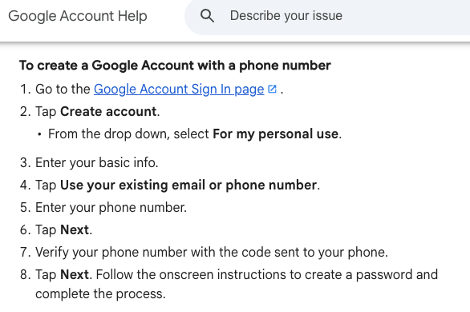
What remains to be seen is whether registration with a phone number will actually open the market for competing providers. If users continue to select Gmail in overwhelming numbers, the objectives of Article 5(8) DMA will not be achieved. As the Higher Regional Court noted with reference to Recital 44 DMA, the provision seeks to open digital markets and lower entry barriers for competitors of the tied product. In our view, persistently low uptake should be read as a sign that the phone route is not “sufficiently attractive” and that Alphabet’s measures are not “effective in achieving the objectives” of the DMA (Article 8(1) DMA).
Overall, the Higher Regional Court of Koblenz has delivered a judgment that private claimants can build on, for four reasons. First, it interprets “requiring” in Article 5(8) DMA from the users’ perspective and tests practical usability rather than theoretical options. Secondly, it holds the anti-circumvention provision in Article 13(4) DMA as enforceable in private claims. Thirdly, it provides for timely relief and did not let an informal dialogue with the Commission stall the case. And fourthly, probably most importantly, it grants a Union-wide injunction from a single court.
National courts have so far seen few DMA claims (the Commission counts fewer than ten cases), but this ruling may well mark a turning point for private DMA enforcement.
Sebastian Steinert, LL.M (Lisbon), Maître en Droit (Paris), is a SCiDA team member and is writing a PhD on the Digital Markets Act under supervision of Prof. Dr. Podszun at Heinrich-Heine University Düsseldorf. He set up the DMA Text Explorer for everyone who is fed up with searching a provision in frustrating PDF documents.