On 24 September 2026, I had the pleasure of attending the 4th Annual UK Digital Markets Competition Regulation Forum at Carpenters’ Hall, London. Hosted by Thought Leaders 4 Competition and chaired by Verity Egerton-Doyle (Linklaters) and Tom Smith (Geradin Partners), the event once again brought together lawyers, enforcers and industry experts. The conference agenda covered almost every corner of the UK’s digital markets enforcement regime, from the current state of the CMA’s SMS investigations and conduct requirements to consumer protection enforcement, private enforcement and the role of the CAT. I left the conference with plenty to reflect on, and here are some highlights from the day:
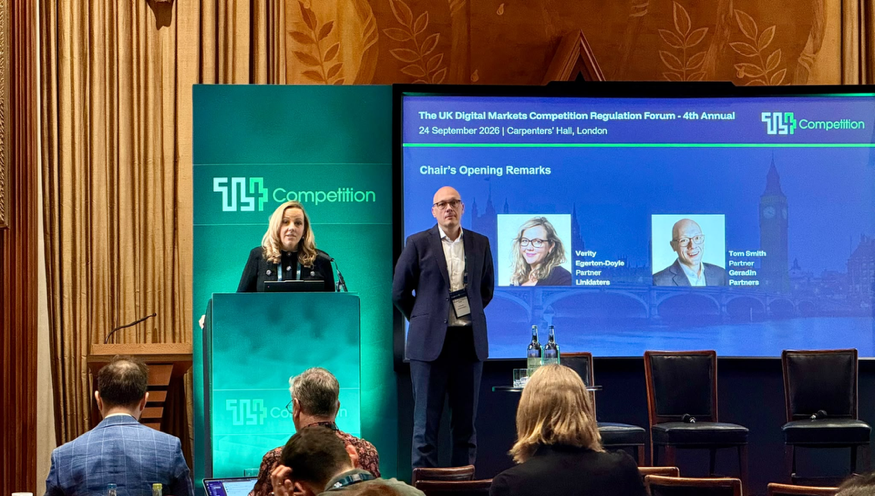
Verity Egerton-Doyle, Partner at Linklaters (UK), opened the conference by reflecting on developments since the first event in 2023. At the time, a new regime was on the horizon; by last year’s conference, it was in operation, and this year’s event offered an opportunity to take stock of the CMA’s work over the intervening year. Verity suggested that the regime’s impact might appear ‘modest’ compared with the DMA but emphasised that this was a design choice. Tom Smith, Partner at Geradin Partners, brought the discussion up to date with the previous day’s developments, referring to the CMA’s further consultation on a proposed user choice conduct requirement for Google and noted that the CMA had done a decent job of implementing the new regime. Both chairs acknowledged the CMA’s work while highlighting the challenging political context and rapidly changing geopolitical environment in which it was taking place.
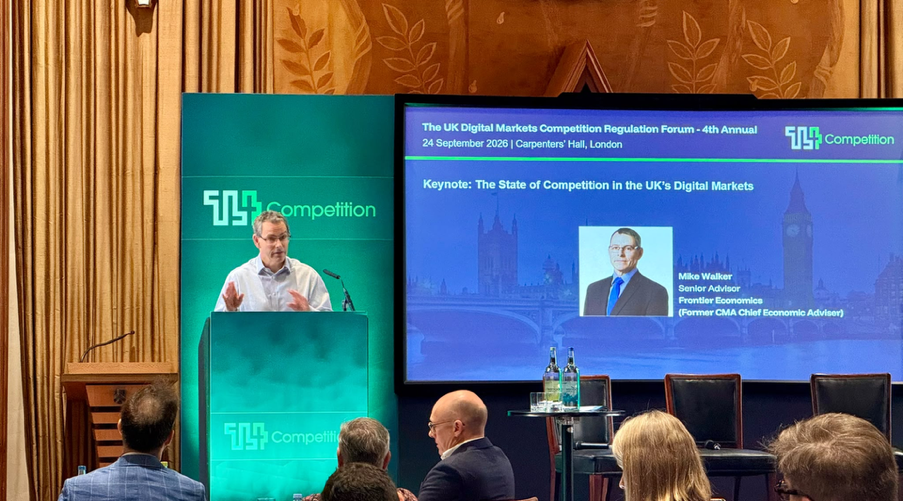
Keynote: Expectations, Market Power and the Challenge of Frontier AI
Mike Walker, former CMA Chief Economic Adviser and Senior Advisor at Frontier Economics, began his keynote with a question: why hasn’t the DMCCA lived up to expectations? His answer touched upon different aspects of enforcement, including government support, the pace of the regime and the effectiveness of remedies. For the first point, he raised concerns about the lack of government support in the UK, contrasting this with the support available to DG COMP, while praising the CMA staff working on the DMU. In his view, the slow pace built into the regime’s design offered a further explanation. Turning to the Google Search and mobile ecosystem inquiries, he stated that the remedies would be unlikely to be sufficient to undermine existing market power. He attributed this partly to a ‘lack of ambition of the legislation’, arguing that the regime was designed to remedy market power rather than prevent it. For that reason, he stated the DMCCA would always lag behind.
Mike further emphasised that frontier AI should be at the forefront of the agenda and he called for timely action. He stated that, when it comes to Frontier AI, Type I errors are preferable to being too late – reminding that this was also the position taken in the Furman Report. He also reflected on how market power could bleed into political power, an issue that has become increasingly prominent in competition law discussions in recent years. Finally, he also called for closer attention to inequality concerns in AI, referring to Power and Progress, co-authored by Acemoglu and Johnson.
Mike’s concluding question was a harder one: what should be done? He argued for a need to focus efforts on preventing market power rather than only remedying it once it had arisen. His final remarks stressed that competition law alone would not be enough and these challenges would also require an industrial policy response. Highlighting dependence on the US and China, he identified two possible approaches: securing bargaining power over ‘AI slack’ and using public procurement. He suggested that public procurement might already form part of the CMA’s strategy and that the authority could be ahead of the game in this respect. His emphasis was on pursuing industrial policy alongside competition policy.
Current State of Conduct Requirements and SMS Investigations and What to Expect Next?
The first two panels, chaired by Verity, explored the current state of conduct requirements and SMS investigations. The first panel brought together Alex Bulfin (Slaughter and May), Yi Ling Ng (RBB Economics) and Matthew Jones (Macfarlanes) to discuss mobile platform commitments and conduct requirements for Google Search. Alex opened the panel with an overview of the timeline and where things currently stand with conduct requirements. Yi Ling reflected on the incentives to comply with voluntary commitments and their effectiveness. She highlighted that the prospect of subsequent conduct requirements and large organisations’ preference for stability are factors creating incentives for such compliance. She also raised concerns about the pace of progress and legal certainty. Matthew commented on why the regime had not been as active as expected and emphasised that it had not been drafted for ex-ante intervention.
The second panel turned to the SMS investigations, with Matteo Foschi (Charles River Associates), Wojciech Pawlak (BRG), Henry Mostyn (Kirkland & Ellis) and Rikki Haria (Freshfields). The first half of the discussion focused on the ecosystem concept in the context of SMS designations and the grouping of digital activities. Moving from scope to potential intervention, the debate then turned to what might follow a Microsoft SMS designation decision, including possible theories of harm. Wojciech highlighted concerns about Microsoft leveraging market power into adjacent activities, drawing on earlier tying cases and touching on interoperability, and Rikki identified licensing restrictions as a possible focus. The discussion wrapped up with the conference’s most popular topic: AI. Rikki discussed the challenges of capturing AI activities, commenting on the Google SMS designation that excludes Gemini. Verity asked how the CMA should account for AI and the changing dynamics it brings. Matteo emphasised its potential to blur competitive boundaries and the need to distinguish current conditions from dynamic developments. Henry argued against the need for regulatory intervention in AI given the existing competition in the market.
In-House Perspectives: Dialogue, Legal Certainty and the Pace of Decisions
The in-house panel offered very interesting reflections on the regime from those navigating it within their businesses. Chaired by Verity, it brought together Jodie-Jane Tingle (Google), Catherine Wylie (Meta), Simon Burden (NatWest Group) and Alex Rennie (Skyscanner). Across their contributions, the discussion returned to a recurring question: how can the CMA preserve meaningful engagement while giving businesses timely decisions and greater certainty?
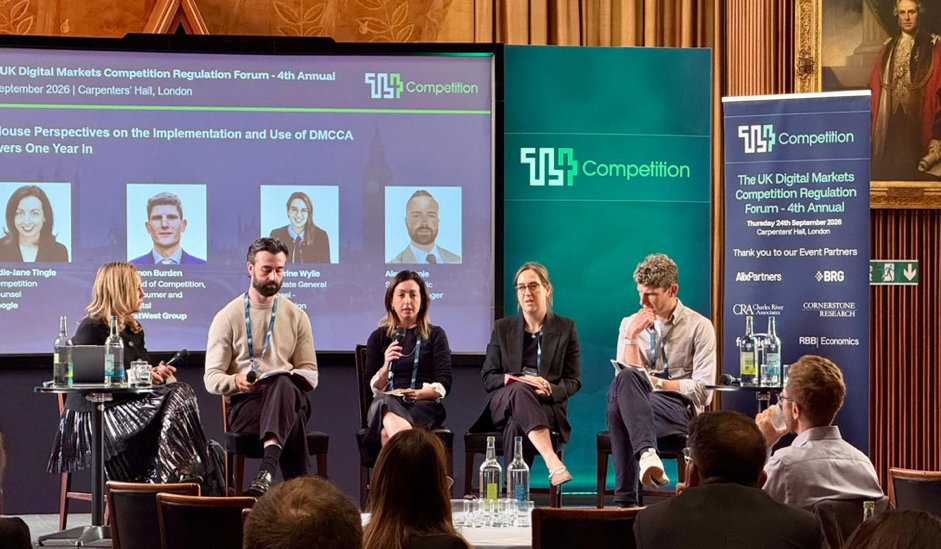
Jodie-Jane was the panel’s only representative of a designated undertaking. Her speech focused on industry engagement and regulatory uncertainty. She welcomed the CMA’s engagement efforts, noting that industry was generally better placed to develop solutions, but stressed that this should not replace the evidence base. She stated that the continuing possibility of new regulation left product teams frustrated and created a difficult environment for fast-moving product development. From Alex’s perspective as an interested third party, roadmaps had not provided full certainty so far. Nevertheless, he considered flexibility more important at that stage, allowing the CMA to respond to market developments. Catherine emphasised that the solution lay in ‘speed’, alongside flexibility and legal certainty, as faster decisions would at least allow businesses to understand their position sooner. The debate turned to the trade-off between pace and engagement. Jodie-Jane contrasted the CMA’s more open dialogue with the DMA’s prescriptive rules and reliance on self-assessment, highlighting that the former is preferable for businesses. Yet, she stated that dialogue shouldn’t come at the expense of slowing the process. Alex also called for faster implementation, noting that two years had passed since Google’s designation by the time the first series of conduct requirements was implemented. He suggested shorter consultation periods and raised the possibility of informal or alternative mechanisms. However, if faster decisions required sacrificing engagement, his preference was to retain full engagement. Simon shared his experience with digital wallets in financial services, contrasting the UK process with the EU antitrust intervention in 2024, which he considered was delivering results. Another important reflection concerned a practical question for businesses operating globally: how far could solutions be aligned across jurisdictions? Catherine called for consistency and harmonisation between the DMA and DMCCA. She noted that multiple layers of requirements created risks of over-compliance and over-regulation. Using Marketplace as an example, she suggested that a business might eventually question whether to discontinue its product.
The panel provided a great opportunity to see how these rules are working for the companies, and to hear their perspective on the trade-off between dialogue and the pace of enforcement. Does meaningful engagement necessarily mean slower decisions, and how should that balance be struck? Calls for greater pace ran through the discussion, but it was possible to see that the DMCCA’s bespoke, dialogue-based approach was preferable to the DMA’s model.
What’s Happening on the Consumer Enforcement Front?
The consumer enforcement panel, chaired by Tom Smith, brought together Christopher Eberhardt (Ashurst Perkins Coie), Tom Hanson (Dentons) and Jesper Akesson (AlixPartners) to discuss the use of the CMA’s new consumer protection powers and common breaches such as drip pricing, fake reviews and subscription contracts.
Christopher opened with an overview of the CMA’s enforcement activity, touching on online choice architecture, default opt-ins and subscription models. Tom then asked whether the CMA’s approach should be seen as aggressive or as a natural starting point under its new powers. Hanson noted that the CMA had sought direct enforcement powers for some time, so their use should not come as a surprise. By giving an example from drip pricing, he highlighted that these should not be seen as new ideas. Jesper drew attention to the economic perspective, distinguishing clear-cut cases from practices that require closer analysis. He also noted that, even where a breach is clear, further analysis may be needed to understand the harm. The discussion then moved to how companies are approaching compliance. Tom Hanson observed that consumer law is now receiving greater attention within companies, having historically struggled to compete with competition law and data protection. Beyond that increased attention, however, there is no single approach, and the strategy depends very much on the specific practice. Looking ahead, the discussion returned to AI, exploring potential concerns around shopping agents, sponsored results in LLMs and how dark patterns might operate through these tools.
Private Enforcement as a Complementary Tool and the CAT as a Global Forum?
Chaired by Tom, the panel brought together Zena Prodromou (Milberg London), Daniel Carall-Green (Fountain Court), Vikram Kumar (Cornerstone Research) and Joe Williams (Herbert Smith Freehills Kramer).
Joe started by reflecting on what opportunities the regime creates for private enforcement, emphasising that it does not create private enforcement rights but a framework where such rights can be created by the CMA. He questioned whether private enforcement could compensate for the CMA’s slow pace, suggesting that it could not in the short term while anticipating such complementarity in the longer term. Whether this would be desirable was, in his view, a more nuanced question. Zena offered both conceptual and practical observations, describing private enforcement as complementary to ex-ante regulation and public enforcement under the digital markets regime, and the DMCCA regime itself as a strong complement to both public and private traditional antitrust enforcement. In practice, however, claims would depend on designation and specific obligations being in place. She suggested that private enforcement under the DMCCA is more prone to standalone claims than follow-on claims, given that the specific conduct requirements and obligations make claims easier to bring. Daniel highlighted the expense of bringing claims, including unavoidable costs associated with expert evidence.
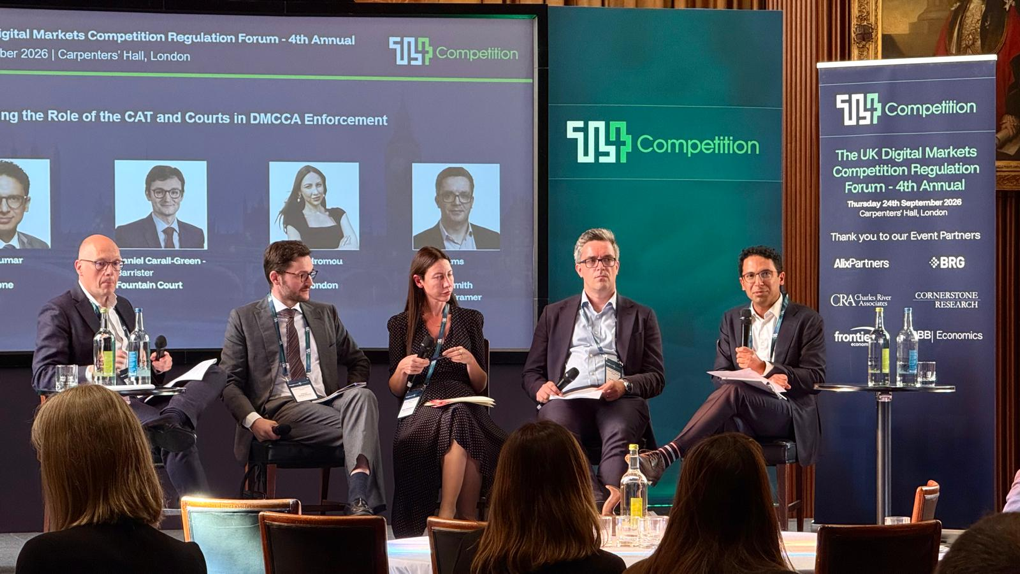
Towards the end, Tom asked whether the UK could become an attractive forum for damages claims with a global scope. Daniel considered this entirely possible, endorsed the court’s quality of decision-making and reach of judgments, reminding that whether this will happen or not will depend on the territorial scope of the rules and the ‘link to UK’ criterion. Vikram touched on the implications for calculating damages, while Zena distinguished technical questions of territoriality from broader policy considerations. She first highlighted the risk of fragmentation if courts reached different conclusions, and noted that the UK’s mature system made the CAT one of the most natural forums, arguing for additional incentives to maximise its geographical reach.
Examining the Interplay between DMCCA Powers and the Wider Enforcement Toolkit
Towards wrapping up the day, the sixth panel explored the wider enforcement toolkit and future resistance of the existing regulatory regime as AI reshapes the markets. The panel, chaired by Tom, brought together Niklas Brüggemann (Weil), David Foster (Frontier Economics), and Michelle Clark (Willkie Farr & Gallagher).
Niklas reflected on a shift from the DMA’s strong initial enforcement towards a more technical approach, with specifications and detailed decisions. He also highlighted the challenge posed by the transition from the Biden to the Trump administration, suggesting that the Commission portrayed competition law enforcement more as regulatory enforcement. He questioned whether decisions this level of detail under the DMA were necessary under a self-executing regime and argued that this approach had encouraged rent-seeking among both smaller technology firms and Big Tech. He identified continuing challenges around proportionality, privacy and integrity, the role of defence within regulatory dialogue, and intervention in less familiar areas such as AI and cloud.
The discussion also examined the continuing role of competition law and raised the question of how competition policy and digital markets regulation could complement one another. Tom observed that earlier conferences had questioned the future of competition law enforcement, whereas the panel was now asking whether technological change might undermine the relevance of the DMA and DMCCA. He also asked whether the question was different for the UK, given the DMCCA’s greater flexibility, and which system would prevail. Niklas saw strong arguments in favour of the UK regime’s flexibility, describing the DMCCA as combining a stiff procedural corpus with discretion. Its effectiveness, however, would depend on the political will to enforce it. Michelle highlighted that the CMA’s active choice to use its new consumer law powers rather than competition law for the Microsoft subscription investigation came as a surprise to her, as it could have been framed as bundling. An interesting reflection was by David, who questioned the long-term relevance of the CMA’s consumer enforcement powers, suggesting that they would become ineffective within a few years as AI agents took over purchasing decisions.
Politicisation in Mergers and Regulatory Enforcement and Its Impact on DMCCA Enforcement
The final panel of the day brought together Davina Garrod (Akin), Ian Giles (Norton Rose Fulbright) and Timothy McIver (Debevoise) and was chaired by Tom. An interesting question raised by Tom was whether practitioners were increasingly engaging lobbyists. Davina described a swing in the enforcement pendulum and greater use of government affairs expertise. Drawing on her experience of cases, she suggested that effective advocacy could attract government attention and emphasised lobbyists’ ability to develop narratives and tell persuasive stories. The discussion then turned to experiences of merger enforcement. Ian identified a substantial decline in merger enforcement and fewer major enforcement cases. He regarded the strategic steer as strongly focused on growth and investment, rather than consumer protection. Davina described the CMA’s approach as thoughtful and intentional and noted that rather than acting as a global antitrust cop, it was focusing on cases that genuinely gave rise to harm in the UK.
A year on from the previous conference, the discussion had moved from designation to what the regime was delivering in practice. Several speakers recognised the CMA’s progress, while others questioned whether its interventions were sufficiently ambitious or moving quickly enough. Comparisons with the DMA provided a yardstick for assessing the regime’s effectiveness and underpinned many of the arguments. AI featured throughout the day, raising questions about the continuing relevance of the existing tools and what to expect next. Ongoing geopolitical tensions and the politicisation of enforcement were also recurring themes throughout the day. There was no single view on how these tensions should be resolved, but they gave the conference plenty to discuss.
Thank you to Peter Miles and the entire Thought Leaders 4 Competition team for putting together such an exciting conference!