The world of competition law is moving faster than ever, and there is no better place to track that momentum than the annual ASCOLA (Academic Society for Competition Law) conference. Held in London and hosted jointly by University College London (UCL) and Kings College London, this year’s event was the largest in the organization’s history with 160 paper presentations.
This year, the SCiDA team, including all 9 team members (Oles Andriychuk, Rupprecht Podszun, Kena Zheng, Pavlina Hubkova, Sarah Hinck, Sebastian Steinert, Anush Ganesh, Jasper van den Boom, Tristan Rohner), had the privilege of joining a vibrant global community of scholars for the 21st ASCOLA Annual Conference.
Key Takeaways for Shaping Competition in the Digital Age
The conference covered a wide range of topics, yet a clear focus on the digital economy and artificial intelligence was evident. Fundamental questions of competition law and analyses of antitrust enforcement were also prominently featured in the presentations. The full program is available on the ASCOLA conference website.
The SCiDA team featured its observations on various plenary panels, addressing major questions regarding competition law:
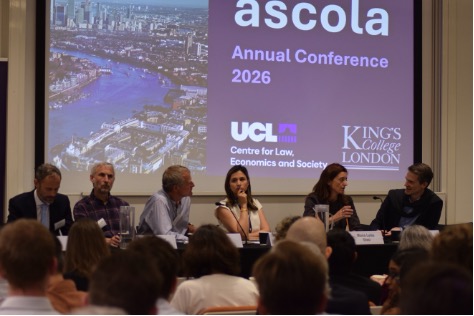
Scholarship Impacts: The conference kicked off with a session, moderated by Rupprecht, on the impact of competition law scholarship on the life of people. The panel featured free speech activist Maria Luisa Stasi (NGO Article 19), Simon Holmes (a top competition law partner turned sustainability activist), and Deni Mantzari (UCL), who is working on mapping the competition law landscape and the impact factors. Drawing the line between interest-driven activism and socially relevant research is delicate, and – obviously – also a question that is often coming up in the emotionally loaded field of digital regulation.
Public vs. Private Enforcement: Another high-profile panel focused on the role of public versus private enforcement in a fragmented world. As competition authorities worldwide come increasingly under direct political influence, can private enforcement play a larger role? Lord Bellamy KC (former UK Under Secretary of State), Eleanor Fox (NYU), Justice Peter Roth (UK Competition Appeal Tribunal), and Caio Pereira Neto (FGV Brazil) discussed these and other questions, moderated by Ioannis Lianos (UCL), alongside representatives from competition authorities: Juliette Enser (UK), Damien Gerard (Belgium), and Vivien Terrien (France). A dominant theme here was the independence of enforcement. Recent incidents involving the politically motivated dismissal of decision-makers at competition authorities in the UK and the US demonstrate that these issues are far from merely theoretical. Eleanor Fox highlighted that the independence of agencies does no longer exist after the US Supreme Court’s Trump v. Slaughter ruling. She reminded the audience of the risks raised by Big Tech platforms as they increasingly blur the line between truth and falsehood. Justice Peter Roth is currently hearing a damages case against Google on Google Shopping. During the conference, Bjorn Lundqvist, the Stockholm competition law professor, broke the news that a Swedish court ordered Google to pay $ 1.5 billion in damages to Klarna. In the German Idealo case, the court had ordered Google to pay € 465 million in damages.
Competition law under pressure worldwide: The digital economy’s power structures lead to a more general criticism of the market economy system. This was palpable in a star-studded panel discussion, opened by Luigi Zingales (Chicago) with a keynote address. Zingales who is known for defending markets against the interests of business. According to Christel Koop (a political economist from KCL) regulation as a model is increasingly coming under pressure. Katharina Pistor (Columbia), author of the “Code of Capital”, stated that the concentration of power in private hands is deeply ingrained in our legal systems. What this means for the role and objectives of competition law was discussed by Michal Gal (Haifa), Dina Waked (Sciences Po), Stavros Makris (UCL), Giorgio Monti (Tilburg), Chris Townley (KCL), and Spencer Weber Waller (Loyola University Chicago).
Innovation Pitches: The third and final day of the conference featured shorter presentations in which researchers could pitch new ideas. It concluded with a creative panel that analyzed science fiction scenarios from a competition law perspective, such as monopoly power in Frank Herbert’s Dune (presented by our Anush Ganesh), the commercialization of brain infrastructure in the series Black Mirror (by Lyuxing Tao) and Hans Vedder’s take on our social media and AI addiction.
Key takeaways:
1. The independence of competition law enforcement is under threat.
One of the over-arching topics at the conference was the political independence of antitrust enforcement. The US Supreme Court had just decided the matter Trump v Slaughter, where one of the finest institutions in antitrust, the FTC, was stripped of its independence from political influence.
2. Competition law is in need of reform from the very fundamentals.
It is noted that competition law must become speedier and more effective, particularly if we wish to tame the power of Big Tech and the growing influence of AI-steering of our economy. More importantly, while some have historically argued that competition law is strictly about consumer welfare, we are now all learning the hard way that this standard is too narrow. However, the answer cannot be to walk away from competition and markets altogether. Instead, the classic ordo-liberal approach, with an updated framework tailored for the 21st century, seems to present the ideal middle ground.
3. Digital competition and AI remain the frontier of competition law research.
Many talks, including from the SCiDA team, focused on digital developments and on AI. These are the frontiers for modern antitrust scholarship. At least 13 of the 22 paper presentation panels were dedicated to DMA, AI, digital matters. If we do not manage to tackle these issues, we will not keep competition law thriving.
The SCiDA Contribution
The SCiDA team shed light on key discussions surrounding the Digital Markets Act (DMA), DMCCA and the broader landscape of digital competition regulations.

Sarah Hinck presented her paper on “Decentralisation & Antitrust in the Digital Economy” on a panel on digital foundations moderated by Eva Fischer (UCL), alongside presentations by Viktoria Robertson (WU Vienna) and Victor Jiawei Zhang (UC Berkeley). She develops decentralisation as a framework for rethinking the role of antitrust law in digital markets dominated by Big Tech ecosystems. Drawing on theories of decentralised state governance and models of centralised, decentralised and distributed information networks, the paper conceptualises digital platform ecosystems as systems of private governance in which a central platform exercises centralised control over the ecosystem and the actors within. The paper shows that decentralisation is already embedded in the normative foundations of competition law, which values the coordination of economic activity through the independent decisions of multiple market actors rather than central planning. Yet the decentralisation principle has not been systematically applied to the governance of digital ecosystems. The paper therefore proposes a decentralisation-oriented approach to competition law and regulation. Such an approach would go beyond opening closed technological structures and seek to redistribute governance authority, enabling a broader range of businesses, developers and users to participate independently in shaping the rules and development of digital ecosystems.

Kena Zheng has presented her draft paper on “Delineating Core Platform Services under the DMA: Mapping the First Enforcement Battlefield between the European Commission and Gatekeepers”. In this paper, she empirically examined the 36 decisions adopted by the Commission regarding designation, de-designation and non-designation core platform services (CPS). She observed that there are 24 decisions where the gatekeepers and the Commission have debates on how to delineate and classify the relevant digital services as CPSs. She provided typologies on three strategies displayed by the gatekeepers to preserve ecosystem integrity and minimize regulatory exposure: (1) denying CPS status, (2) broadening CPS scope, and (3) narrowing CPS scope. In response, the Commission employed three counter-approaches: (I) ecosystem-based analysis, (II) redefining and interpreting certain DMA provisions and concepts, and (III) mirroring market definition assessments under competition law. Based on a benefit-cost analysis, she concluded that there is an asymmetric risk allocation and proposed that the operational standards of Article 13(1) DMA, the anti-circumvention provision, should be further clarified through formal Commission guidelines or landmark EU case law. In this panel, Jasper van de Boom provided his comments on the paper presented by Franziska Guggi on “Data-driven competition law enforcement”.

Together with Juliane Mendelsohn, Tristan Rohner presented on “Data, Power and Democracy”. They argued that market-based regulations and remedies should take harm to democracy into account. The basis for this is the competition-democracy-nexus. Harms to markets and harms to democracy can overlap in many cases and can then also be remedied together. They described the origins of these harms in the digital economy, focusing on processes of datafication and platformisation, and analysed several harms to competition, fundamental rights, and egalitarian discourse resulting from the practices in data-driven digital ecosystems.
They were joined on the panel by Liang Li (Limits of EU competition law and excessive data collection), Gunn Jiravuttipong (Temu’s Antitrust Paradox) with Julian Nowag as discussant and Laura Zoboli as chair.
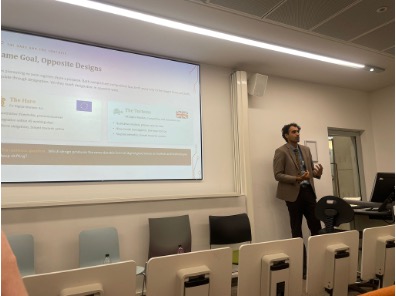
Anush Ganesh presented the co-authored paper with Jasper van de Boom, and Kena Zheng, titled: The Hare and the Tortoise: Appraising the Different Designation Procedures in EU and UK Digital Regulation. The headline contrast is familiar: the DMA can designate a gatekeeper within 45 working days through quantitative thresholds, while the DMCCA mandates a nine-month investigation requiring rigorous forward-looking analysis of substantial and entrenched market power and strategic significance. What the two regimes have done is locate their analytical work at different points in the regulatory process, and that choice determines where each framework is most likely to make mistakes and how it catches them. The DMA concentrates obligations at the designation gate and picks up errors later, in court and through non-compliance proceedings. The DMCCA spends its analytical budget before designation and delivers bespoke conduct requirements that are harder to challenge but narrower in reach. Neither is categorically superior. They are answering different regulatory fears: the fear of letting gatekeepers slip through against the fear of binding the wrong firms on thin evidence.
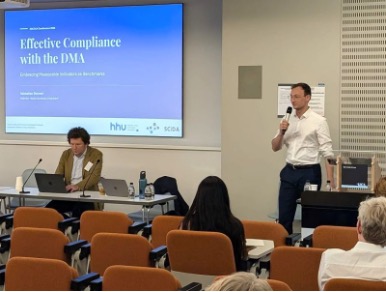
Sebastian Steinert presented on effective compliance with the DMA. While the DMA has had positive impact it has not yet achieved its full potential, partially due to gatekeepers’ “creative” compliance measures which do not achieve the regulations’ objectives. In his paper, which forms part of his PhD research, Sebastian conceptualizes the DMA as outcome-based regulation that requires gatekeepers to demonstrate market changes for compliance to be effective. He proposes to use indicators as measurable benchmarks for compliance. By analysing the Gatekeepers’ annual compliance reports he found that they are reluctant to embrace indicators and generally negate the relevance of market outcomes for compliance. The European Commission’s DMA enforcement activity, on the other hand, relies on the notion of effective compliance and indicators, but it applies them with hesitantly. To support the effectiveness of the DMA, Sebastian proposes certain presumptions in formal proceedings based on effectiveness indicators. Juliane Mendelsohn acted as discussant for this paper and Sebastian is grateful for her helpful comments and feedback. The presentation also featured a discussion with the audience including questions from Jens-Uwe Franck (Mannheim), Marco Botta (EUI), Eckart Bueren (Göttingen), Pankhudi Khandelwal (EUI), Jan-Frederick Göhsl (Münster) and Ondrej Blažo (Comenius University).
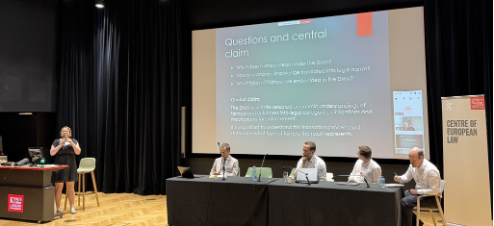
Pavlina Hubkova presented her new project entitled “Fairness under the DMA: An Exercise in Epistemic Translation”. She has been exploring the concept of fairness under the Digital Markets Act (DMA), treating it as an exercise in epistemic translation: specifically tracking how fluid economic knowledge about fairness is translated into enforceable legal text. Her presentation and the following discussion have also highlighted a broader, more urgent point for our community: we need to expand how we talk about economics in competition law. For too long, the competition legal field has treated “economics” as entirely synonymous with “efficiency”, “consumer welfare”, or “calculating effects”. However, the field of economics contains and offers vastly more than that. If we want to properly understand and effectively apply the logic of the DMA, we should embrace the full breadth of economic theory. The panel on pitching new ideas also featured presentations by David Reader and Magali Eben (University of Glasgow), Justin Lindeboom (University of Groningen), Małgorzata Kozak (Polish Academy of Science), Zlatina Georgieva (Utrecht University), and Linus Hoffmann (University of Strathclyde).
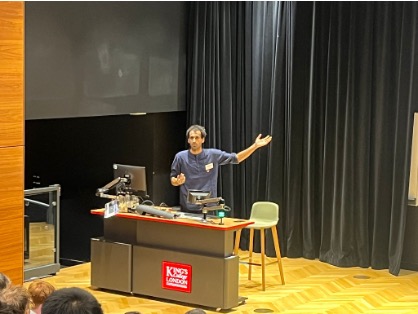
At the closing plenary panel, Anush Ganesh presented “Abuse of Dominance, Self-Preferencing, and the Quasi-State in Frank Herbert’s Dune”, reading the Dune universe through the lens of Article 102 TFEU, with the spice mélange as an essential facility, Emperor Shaddam IV’s conduct as a self-preferencing abuse, and the quasi-state doctrine from the European Super League judgment as the analytical anchor. What made the presentation genuinely special, though, was the cast of SCiDA colleagues and 2 Humboldt University PhD candidates who brought it to life on stage: Kena, Jasper, Sarah, Pavlina, Maximilian Wolters, Tristan, Simon de Ridder, and Ece each took on characters and roles that turned a conference paper into something more like a performance. The aim was never merely to be playful but to show that speculative fiction, when read carefully can make visible competition law problems that more conventional doctrinal analysis tends to flatten. It is fair to say that this particular cast made that argument far more convincingly than the paper alone ever could have. This was the most memorable session of the week.
Contributions to the Side ASCOLA events
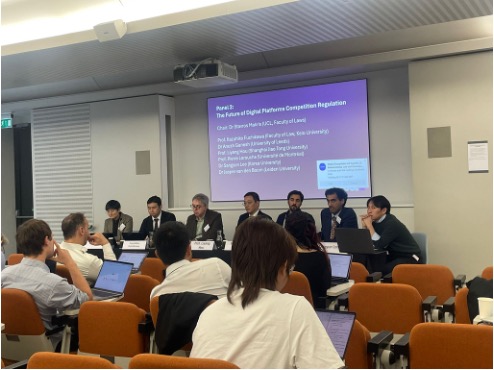
Anush Ganesh attended the ASCOLA side event on Digital Ecosystems and Agentic AI at the UCL Faculty of Laws, where he presented on India’s digital competition landscape. His contribution traced the arc from the Competition Commission of India’s enforcement record under the Competition Act 2002 through to the withdrawal of the Draft Digital Competition Bill and the question of what comes next. Cases including the WhatsApp privacy policy order, the Play Store policies matter, and the FHRAI complaint against MakeMyTrip and OYO illustrate that the CCI already possesses real tools to reach self-preferencing, unfair platform terms, and data-driven exclusion without a dedicated ex ante regime. His central argument, drawing on work co-authored with Mohit Yadav and Gaurav Pathak, was that the answer for India should be a bespoke framework responsive to its own market structure and institutional realities rather than a wholesale transplant of the EU DMA model. He also maintained that capacity building is essential for the CCI to be able to enforce any digital markets legislation effectively.
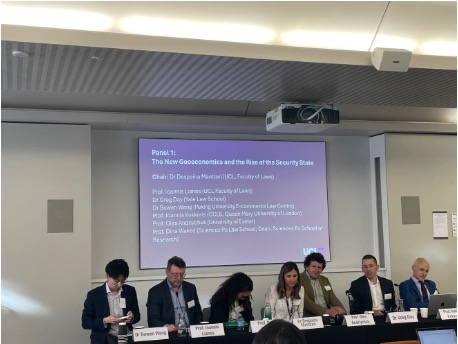
Oles Andriychuk presented his research at the ASCOLA side event in UCL as well. His presentation was focused on examining the new digital market regimes through the prism of the theory of legal realism. The key thesis proposed is that the new digital market regimes both in the EU and UK are designed to be instruments for shaping digital markets. This top-down approach presupposes an active and decisive role of public interests. Unlike the dominant bottom-up discourse examining the effectiveness of the DMA/DMCCA through the prism of business users and measuring the performance of the new regime by the compliance/non-compliance yardstick, the legal realist perspective promotes a more dirigiste approach to the new regimes.
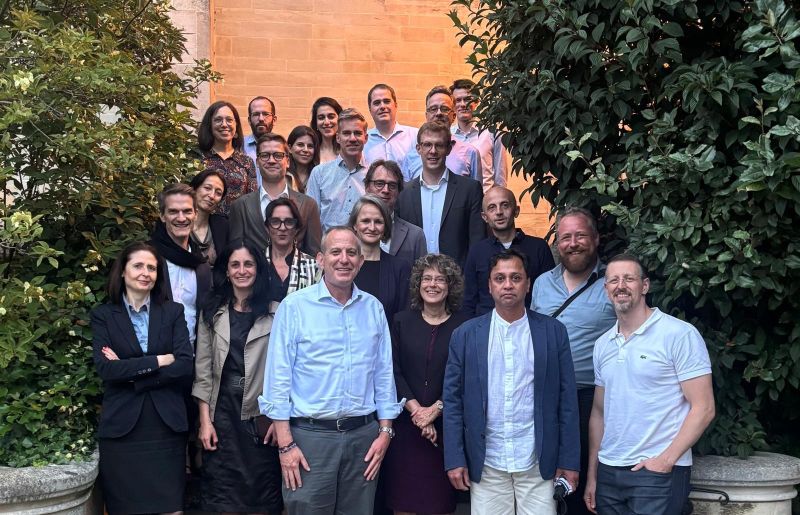
Rupprecht Podszun attended a side event at Oxford University invited by Ariel Ezrachi, Michal Gal and Peter Picht. Rupprecht spoke at a roundtable discussion at Pembroke College. The expert workshop addressed questions surrounding AI. Rupprecht painted a bleak picture – he sees the concentration of power in a few hands pushed forward through AI. The cure is not competition law, in his view, but a sensible competition-driven economic policy. With this in mind, he spoke about the recent AI report that he edited with a team for the German Ministry of Economics, and the Monopoly Commission’s new expert opinion on industrial policy.
For the SCiDA team, one of the best takeaways was meeting and reconnecting with so many great scholars, colleagues, and friends at the annual ASCOLA gathering.
A massive thank you to the organizers and the entire ASCOLA community for putting together such a stimulating and record-breaking event. We return energized and ready to channel these insights into our ongoing work!